
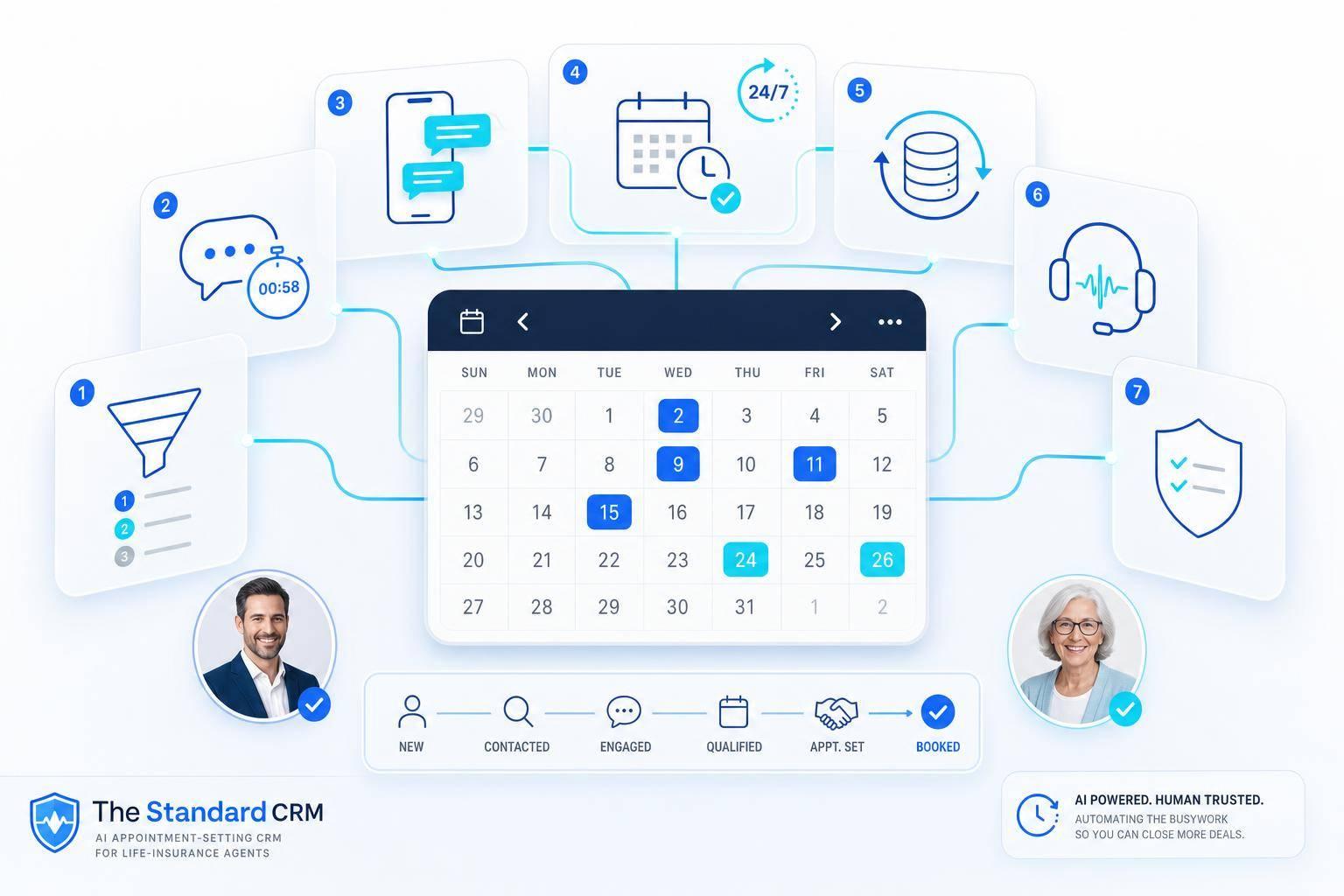
7 Ways AI Can Help Life Insurance Agents Close More Deals
Life insurance agents face challenges like slow response times, inconsistent follow-ups, and wasted effort on unqualified leads. AI tools are changing the game by automating repetitive tasks, enabling agents to focus on building client relationships and closing deals. Here’s how AI can make a difference:
- Predictive Lead Scoring: AI ranks leads by purchase likelihood using data like demographics and behavior, helping agents prioritize high-value prospects.
- Instant Responses: AI replies to inquiries in under a minute via voice, SMS, or email, boosting conversion rates by responding faster than competitors.
- Automated Follow-Ups: AI schedules and personalizes follow-ups across multiple channels, ensuring consistent outreach and higher close rates.
- Personalized Outreach: Conversational AI tailors messages based on prospect behavior, making interactions feel relevant and timely.
- Appointment Scheduling: AI automates booking and sends reminders to reduce no-shows, saving agents hours each week.
- CRM Automation: AI streamlines data entry, handles compliance requirements, and flags errors to improve efficiency.
- Call Insights and Coaching: AI analyzes calls to identify improvement areas, helping agents refine their sales techniques.
![7 Ways AI Helps Life Insurance Agents Close More Deals [Key Stats]](https://assets.seobotai.com/undefined/6a2abcd886c50afdb5becdab-1781187625552.jpg)
7 Ways AI Helps Life Insurance Agents Close More Deals [Key Stats]
GENIUS Ways to Use AI as a Life Insurance Agent
sbb-itb-b54a2b8
1. Predictive Lead Scoring
Let’s face it - chasing unqualified leads is a huge drain on both time and money. Predictive lead scoring changes the game by using AI to analyze behavioral and demographic signals. For example, it looks at actions like how long a prospect spends on a term life insurance quote page, searches for phrases like "how much life insurance do I need?", or life events such as buying a new home. Based on this data, it ranks leads by how likely they are to buy a policy.
This isn't just guesswork. The AI evaluates over 60 data points for each prospect. It digs into key demographics like age, income, coverage timelines, and carrier history. It also tracks life event triggers - think new baby or new job - and even interaction history in the CRM. This includes how often the prospect was contacted, how quickly they responded, and their level of digital engagement. The result? A finely tuned shortlist of high-intent leads that agents can focus on.
By identifying top-quality leads right away, agents can spend their time where it counts.
"When producers shift from cold-contacting 200 undifferentiated leads to working a 40-lead shortlist flagged by AI, close rates improve immediately." - Arete Intelligence Lab
The results speak for themselves. Agencies report spending 47% less time on low-intent leads, dedicating 23% more effort to high-value prospects, and seeing close rates jump by 27%–41% in just 90 days.
Here’s a real-world example: In early 2026, a life insurance agency in the Southeast U.S. was spending $34,000 a month on leads with a 9.2% close rate. After just 60 days of using AI to prioritize leads and manage response times, their close rate climbed to 14.7%. That improvement translated into an extra $280,000 in annual premium - all without increasing their budget. It’s not about spending more; it’s about spending smarter.
2. Instant AI Responses Across Voice, SMS, and Email
In life insurance sales, speed isn’t just important - it’s everything. 78% of consumers choose the first agent who responds, regardless of experience or pricing. That means the clock starts ticking the moment a prospect submits a quote request. Every minute of silence increases the likelihood they’ll move on to someone else. Quick responses are essential for converting high-intent leads.
"78% of consumers buy from the first agent who responds. Not the best agent. Not the cheapest carrier. The first responder." - Josh Kay, Founder, RenewalEngineAI
Here’s how much timing matters: responding within one minute instead of five can lead to a 391% higher conversion rate. But wait an hour, and your chances of qualifying that lead drop by a factor of 10. Unfortunately, manual follow-ups often take an average of 47 hours. That’s where AI-powered responses shine, delivering replies in under a minute across multiple channels and ensuring no opportunity slips through the cracks.
The Standard CRM bridges this gap seamlessly. As soon as a lead comes in - whether it’s from a web form, a Facebook ad, or an inbound text - the system instantly sends a response via voice, SMS, and email. And it doesn’t stop there. Even during off-hours, the AI engages prospects by asking qualifying questions about coverage needs, budgets, and health details. It then shares a calendar link to schedule an appointment. By the time agents start their workday, meetings are already set, and detailed prospect information is waiting in the CRM.
Here’s a comparison of response times between traditional methods and AI-powered systems:
| Channel | Manual Average | AI Response Target |
|---|---|---|
| Web Form | 47 hours | Under 60 seconds |
| Inbound Text | 2–4 hours | Under 60 seconds |
| Phone Call | 30–90 seconds | Under 30 seconds |
| Referral Email | 4–24 hours | Under 60 seconds |
This rapid-response strategy dramatically improves contact rates, increasing them from 30–50% to an impressive 70–80%. It’s the difference between a thriving sales pipeline and one that’s leaking opportunities.
3. Automated Follow-Ups and Nurture Sequences
Capturing a lead's attention with a quick response is only the first step. To truly convert leads, consistent and thoughtful follow-ups are essential. Research shows that 5 to 7 touches are usually necessary to turn an inbound insurance lead into a customer. Unfortunately, many agents stop after just two or three attempts, leaving potential deals on the table.
This is where The Standard CRM steps in, automating the follow-up process with a mix of SMS, email, and voicemail messages. These outreach efforts are carefully timed and personalized, ensuring your agency stays top-of-mind as prospects weigh their options.
What makes this system even more effective is its ability to adapt based on a prospect's behavior. For example, if someone clicks a link in an email or opens a message, the CRM adjusts its approach accordingly. This kind of tailored outreach has been shown to increase conversion rates by 3.1 times.
"Independent agencies that deploy 5+ touch automated lead nurture sequences bind 2.8× more policies from the same lead volume than agencies using 1–2 manual contact attempts." - IIABA's 2025 Best Practices Survey
The data tells a compelling story. Take a look at how cumulative close rates improve as follow-up touches progress:
| Touch | Timing | Cumulative Close Rate |
|---|---|---|
| 1 | Day 1 | 9.2% |
| 2 | Day 2 | 14.8% |
| 3 | Day 4 | 22.1% |
| 4 | Day 7 | 31.6% |
| 5 | Day 14 | 38.4% |
| 6 | Day 21 | 41.2% |
As the system gathers data, it also ensures a seamless transition from automated messages to direct agent involvement. When a prospect shows interest, the AI immediately alerts agents, providing a full history of interactions. This allows agents to step in with a warm, informed approach. Agencies using this method report a 40–60% boost in lead engagement and a 15–25% increase in quote-to-bind ratios.
4. Personalized Outreach at Scale with Conversational AI
Automated follow-ups are great for consistency, but conversational AI takes it up a notch by tailoring messages for each prospect. Whether you're contacting 10 people or 1,000, the messaging feels personal, timely, and relevant. By building on the foundation of automated follow-ups, conversational AI adjusts each interaction based on the unique behavior of the prospect.
Take The Standard CRM, for instance. It uses AI bots equipped with customized scripts for life insurance, final expense, annuities, and more. Imagine a prospect fills out a form asking about term life insurance. Instead of a generic response, the AI acknowledges their specific interest, references their timeline, and replies in as little as 90 seconds. This speed matters - a lot. Agents who respond within 5 minutes are 100 times more likely to connect with a prospect than those who wait 30 minutes.
What sets conversational AI apart is its ability to pick up on behavioral cues. For example, if a prospect opens an email multiple times but doesn’t schedule a call, the system notices and sends a follow-up tailored to that behavior - different from the response a one-time email opener would receive. This dynamic approach not only ensures more personalized follow-ups but also allows agents to focus on the most promising leads.
"AgentAI amplifies your efforts by handling repetitive communication so you can focus on high-value conversations that close deals." - Agent CRM
Here’s a real-world example: In early 2026, a life insurance agency in Buckhead, Atlanta, swapped 400 weekly cold calls for an AI-powered inbound system. In just 60 days, they saw remarkable results - 38 qualified leads per month, 14 booked appointments, and 8–9 policies closed. Even better, their cost per acquisition dropped from $310 to $87.
And it’s not just businesses that are embracing AI. A recent survey found that 51% of consumers would use an AI tool to research life insurance, and 55% would use one to shop for it. By meeting prospects where they are and personalizing outreach, conversational AI is reshaping how agents engage with leads, boosting both productivity and results.
5. AI Appointment Scheduling and Calendar Automation
A smooth booking process can make or break even the best outreach efforts. Every extra step risks losing a potential client. AI simplifies this by being available 24/7, instantly responding to inquiries, and seamlessly scheduling appointments directly into an agent’s calendar - no endless back-and-forth required.
Here’s the reality: agencies miss around 39% of inbound calls during business hours and over 60% after 5 PM or on weekends. And when prospects don’t hear back within an hour, they’re 60% less likely to make a purchase. Automating scheduling ensures quick follow-ups and locks in appointments without unnecessary delays.
AI tools also handle pre-qualification during the booking process. By gathering key details - like coverage type, budget, timeline, and basic health information - via SMS or email, they create a structured prospect profile before the call. With tools like Standard CRM, agents step into conversations fully prepared, armed with all the context they need.
To top it off, automated reminders help reduce no-shows by sending confirmation texts, appointment details, and document checklists. Plus, every interaction is automatically logged into the CRM. This approach not only keeps everything organized but also saves agents 8 to 10 hours a week. That’s extra time they can spend focusing on what really matters: closing deals.
6. CRM Workflows and Compliance Support
CRM tools have evolved beyond just managing customer relationships - they now handle repetitive, time-consuming tasks that often eat into an agent's selling time. Think about the hours spent chasing leads, completing carrier applications, or navigating ever-changing regulations. These tasks, while necessary, can be a major distraction. That’s where AI-powered CRM tools step in, automating these processes to free up more time for sales.
On the data front, AI simplifies things further. It captures all the critical details from a discovery call - like coverage goals, beneficiary names, and health disclosures - and automatically syncs them to the correct CRM fields. No more manual note-taking! Optical Character Recognition (OCR) technology extracts key data with precision, ensuring everything is updated in the CRM without errors. Plus, AI can flag incomplete or inaccurate submissions (commonly called "Not In Good Order" or NIGO) before they even reach the carrier. This proactive approach helps agents avoid underwriting delays that could jeopardize deals. These efficiencies also lay the groundwork for better compliance management.
Speaking of compliance, it’s a high-stakes game. Violations of the Telephone Consumer Protection Act (TCPA) can result in hefty fines - ranging from $500 to $1,500 per message. And starting January 27, 2026, the FCC’s one-to-one consent rule will require brand-specific consent, rather than bundled permissions from lead generators. The Standard CRM is built to handle these challenges, verifying consent, adhering to state-specific dialing restrictions, and even recognizing natural language opt-outs like "stop calling me." This ensures contacts are suppressed across all communication channels.
For SMS outreach, compliance gets even more technical. A2P 10DLC registration is now mandatory for business messaging. The Standard CRM takes care of structuring automated SMS workflows to meet carrier requirements, so agents don’t have to worry about the nitty-gritty details. Every interaction - whether it’s a call, text, email, or note - is logged, creating an audit-ready record. This comprehensive tracking can be a lifesaver if regulators ever come knocking.
7. Real-Time Call Insights and Sales Coaching
Sales managers can't possibly review every call, which is where AI steps in. By scanning call recordings, AI identifies and highlights the most critical moments. On average, AI conversation intelligence uncovers 6.2 coachable moments per producer per week - moments that managers might have completely missed otherwise - all while reducing call review time by an impressive 63%.
"Conversation intelligence platforms use AI to analyze recorded producer calls and video meetings, surfacing specific talk patterns, objection-handling gaps, and compliance risks that sales managers can address in coaching sessions." - Arete Intelligence Lab
AI doesn't just save time; it sharpens coaching. Instead of offering general feedback, it pinpoints specific moments in calls where a prospect raised objections or where an agent struggled. This allows managers to focus their guidance exactly where it’s needed. For agencies aiming to improve their less-experienced producers, the results speak volumes: bottom-quartile agents at mid-market agencies saw their close rates jump 18% in just six months thanks to AI-driven coaching. By addressing these gaps, agents not only close deals faster but also with greater efficiency.
And the benefits don’t stop there. Agencies leveraging AI-assisted workflows reported a 28% increase in average premium revenue per producer within a year. This isn’t just about more deals - it’s about better deals, closed faster, and with fewer mistakes.
For agencies operating in states with strict call recording laws, AI tools now offer solutions that don’t store audio or video files. Instead, they process and organize meeting notes in real-time, ensuring agents can still benefit from coaching insights without worrying about compliance issues.
Conclusion
The seven AI-driven strategies outlined - from predictive lead scoring to real-time call coaching - share a unifying theme: they eliminate the barriers that slow agents down, replacing inefficiency with speed, accuracy, and consistency. Agencies leveraging these tools are seeing remarkable results: a 31% increase in policies closed per producer, quote-to-bind cycle times nearly halved, and an average cost reduction of $187 per acquired policy. These improvements directly translate to higher quarterly revenue.
One key takeaway stands out: don't attempt to automate everything at once. Marcus Tillman, VP of Sales at a $28M independent agency, learned this firsthand. After investing $62,000 over 18 months, his team pinpointed their biggest challenge - lead prioritization. By adding an AI-driven scoring layer to their CRM, they boosted their close rate from 19% to 27% in just five months, resulting in $340,000 in annualized premium growth.
"The clarity we got from the report was worth more than all three of the tools we had already bought." - Marcus Tillman, VP of Sales and Distribution, $28M Independent Agency
Focusing on a single high-friction area - whether it's follow-up delays, slow lead responses, or missed appointment reminders - can create measurable results. Try a 30-day pilot program targeting one of these pain points, and track metrics like contact rates, close ratios, and cost per acquisition before and after implementation. These measurable wins provide a strong foundation for scaling AI tools effectively.
"AI won't replace life insurance agents - but agents who use AI will absolutely outperform those who don't." - Agent Advantage
The divide between agents who embrace AI and those who don't is becoming increasingly evident. The tools are available, the results are proven, and the cost of entry is lower than many expect - starting at around $300 per month. The only question left is: where will you start?
FAQs
What should I automate first with AI in my life insurance sales process?
Start by streamlining your lead follow-up process with automation. Research indicates that responding to leads within five minutes increases their likelihood of engagement by 21 times. However, the average response time in the industry is a staggering 48 hours. Using automated follow-up sequences in The Standard CRM, you can send instant, personalized responses and maintain consistent communication without lifting a finger. This approach ensures leads stay warm while giving you more time to focus on meaningful client interactions.
How does AI lead scoring know which prospects are most likely to buy?
AI lead scoring helps predict how likely a prospect is to make a purchase by examining factors like their behavior, demographics, and timing. With machine learning at its core, it processes data such as website visits, email interactions, completed forms, and even major life events. By comparing this information to historical conversion patterns, it pinpoints prospects with strong intent. This allows agents to prioritize leads based on clear, data-driven engagement indicators, ensuring their efforts are focused on those most ready to take action.
How do I stay TCPA-compliant when using AI for texts and calls?
To ensure your AI-driven texts and calls remain compliant with TCPA regulations, focus on consent and transparency. Before initiating any automated outreach, always obtain explicit permission and provide a clear opt-out option.
If your outreach involves call recordings, be aware of the legal requirements in your area. While federal law permits one-party consent, some states mandate that all parties involved must agree to the recording.
Using CRM tools equipped with built-in A2P messaging and TCPA compliance features can streamline the process. These tools help ensure that your communications align with regulatory standards, reducing the risk of violations.